Champions League Betting Odds: How UK Bookmakers Price Europe’s Top Competition
 Available in US

Champions League nights carry a specific energy in the UK betting market. Tuesday and Wednesday evenings during the European season produce some of the tightest odds, deepest markets and highest per-match turnover outside the Premier League. Football generated £1.3 billion in remote betting GGY in the year to March 2025, and Champions League fixtures punch well above their weight in that total. Here’s how UK bookmakers approach pricing Europe’s flagship club competition — and where the structure creates openings for bettors who know where to look.
How UK Bookmakers Price Champions League Matches
Champions League pricing starts with the same models that power domestic leagues — expected goals, team strength ratings, home advantage adjustments — but with complications that Premier League fixtures don’t present. Cross-league matchups force the pricing team to bridge different data ecosystems. How do you weight a Bundesliga team’s xG data against a Serie A side’s defensive metrics when the two leagues have different tempos, pressing intensities and refereeing standards?
The answer, in practice, is that operators lean heavily on historical Champions League performance data rather than trying to translate domestic form directly. A team’s results in European competition over the past three to five seasons carries significant weight in the initial price, with domestic form used as an adjustment factor. This creates a specific type of inefficiency: teams that have improved dramatically in their domestic league but lack recent Champions League pedigree tend to be undervalued in the opening prices.
Flutter Entertainment, the parent company behind multiple major UK brands, generated $16.38 billion in revenue across 2025. The Champions League is a key revenue driver for operators of that scale, and pricing resources reflect it. The major bookmakers dedicate specialist trading teams to European competition — meaning the core markets (1X2, over/under, both teams to score) are priced with care and efficiency. The edges I find are rarely in those headline markets.

Market Availability From the Group Phase to the Final
The new Champions League format — a 36-team league phase replacing the old group stage — expands the number of fixtures dramatically. More matches means more markets and, crucially, more matches involving teams that UK bettors and bookmakers know less about. A league-phase fixture between two clubs from smaller European leagues won’t attract the same trading scrutiny as an English or Spanish club’s match, and the margins on those lower-profile fixtures are measurably wider.
During the league phase, expect 120-200 markets per match on the major UK bookmakers for high-profile fixtures and 80-130 for lower-profile ones. Player markets, corner counts and booking points are available on most league-phase matches but with wider margins than you’d see on the same markets in the Premier League. As the tournament narrows to the knockout rounds, market depth increases and margins tighten. The quarter-finals and semi-finals approach Premier League-level coverage, and the final itself is one of the most deeply traded single matches of the year.
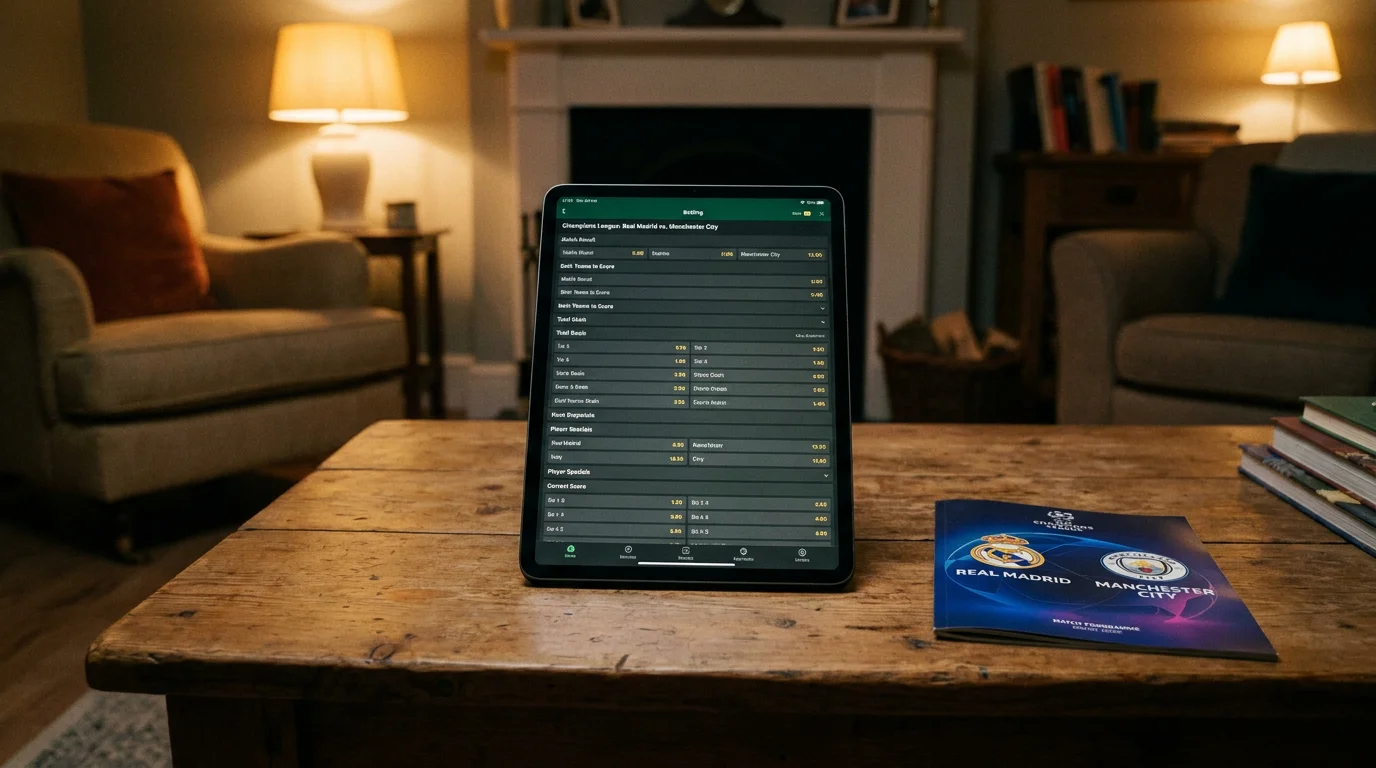
Outright markets — tournament winner, to reach the final, to reach the semi-finals — run throughout the competition. These are where I focus most of my Champions League analysis, because the structural changes to the format (more teams, different seeding, a single-leg round of 16 for some ties) create uncertainty that the outright market doesn’t price perfectly. The new format’s path-to-the-final dynamics are complex enough that casual bettors won’t model them, and the pricing reflects that informational gap.
Where to Find Value in Champions League Betting
Two patterns have delivered consistent value for me across European competition. First, league-phase matches where both teams have already secured qualification or elimination before the final matchday. These “dead rubber” fixtures feature squad rotation, reduced intensity and unpredictable scorelines. The bookmaker’s pricing model, which is calibrated on competitive matches, tends to overestimate the favourite’s advantage in matches where motivation is asymmetric or absent.

Second, first-leg knockout ties consistently produce fewer goals than the market expects. Home teams in first legs tend to play conservatively — protecting a clean sheet is more valuable than scoring away goals under the new format — and the over/under line often doesn’t adjust far enough downward. Denise Coates of bet365 noted in company filings that strategic decisions around market positioning reflect long-term sustainability analysis. The same principle applies to bettors: identifying persistent biases in Champions League pricing is more sustainable than trying to predict individual match outcomes.
Best UK Sites for Champions League Coverage
Coverage quality for the Champions League is more uniform across UK bookmakers than for domestic lower-league football. Every major operator treats the tournament as a premium product, which means deep markets, competitive pricing and live streaming availability on most fixtures. The differentiation comes in the details.
Some operators offer enhanced odds or price boosts specifically on Champions League fixtures — Tuesday or Wednesday “specials” that provide genuine uplift on selected markets. Others bundle Champions League matches into free-to-play prediction games that, while not directly profitable, build engagement and occasionally unlock bonus credits. The promotional calendar around Champions League matchweeks is dense, and comparing offers across three or four bookmakers before each round of fixtures can extract meaningful value from the operator competition.

For in-play betting specifically, the Champions League is well served by live streaming through UK bookmakers. Most licensed operators stream matches featuring English clubs, and some offer broader coverage across the tournament. Given the evening kick-off times (typically 5:45pm and 8pm UK time), the in-play window aligns perfectly with peak UK betting activity, meaning live markets are liquid and margins are closer to pre-match levels than you’d find on, say, a midday South American fixture.
The Champions League rewards preparation more than most competitions. The cross-league matchups, the format complexities and the emotional intensity of knockout football all create conditions where careful analysis can find edges that the market — priced for volume and efficiency on the headline markets — leaves unattended on the margins.

Do UK bookmakers offer bet builders for Champions League matches?
Yes. All major UK bookmakers offer bet builder functionality on Champions League fixtures, combining selections like match result, over/under goals, both teams to score and player props into a single bet. Market availability within the builder may be slightly thinner for lower-profile matches compared to Premier League fixtures.
Are Champions League odds tighter than Premier League odds?
On high-profile Champions League fixtures involving top-tier clubs, 1X2 margins are comparable to Premier League levels — typically 103-105% overround. Lower-profile league-phase matches carry wider margins, often 105-108%, because trading volume is lower and cross-league pricing introduces more uncertainty.
Published by the Football Betting Sites team.