
Football Accumulator Betting: Boosts, Insurance and How Bookmakers Price Accas
 Available in US

Nearly half the UK adult population — 47 per cent according to the latest Gambling Commission survey — participates in some form of gambling within any four-week window. And among football bettors, no product generates more excitement or more heartbreak than the accumulator. The Saturday afternoon acca is practically a cultural institution: four, five, six legs stacked together for a shot at turning a fiver into a few hundred quid. Social media feeds fill up with near-miss screenshots, and bookmakers build entire marketing campaigns around acca boosts and insurance offers designed to keep you adding one more leg.
I have spent the better part of a decade analysing UK sportsbook pricing, and accumulators are the product where I see the widest gap between what punters believe they are getting and what they actually receive. The odds look generous, the boost percentages sound impressive, and the insurance offers feel like a genuine safety net. The maths underneath tells a different story. This article walks through how accumulators are actually priced, where the hidden margin compounds, and which promotional add-ons deliver genuine value versus which ones exist purely to increase handle.
How Bookmakers Price Football Accumulators
A punter once asked me why his ten-fold accumulator at combined odds of 850/1 had “never come in” despite placing one every week for three years. I did the maths with him. The true implied probability of his typical ten-fold — based on fair odds stripped of margin — was roughly 0.04 per cent. That translates to one winner every 2,500 attempts on average. Three years of weekly bets is around 156 attempts. He was not unlucky; he was working inside a probability framework that required a 48-year time horizon to expect a single payout.
Accumulator pricing is deceptively simple in principle: multiply the decimal odds of each leg. A three-fold at 2.00, 2.50 and 1.80 returns 2.00 x 2.50 x 1.80 = 9.00. Your GBP 10 stake returns GBP 90 if all three legs win. But this straightforward multiplication masks the compounding effect of the bookmaker’s overround — the built-in margin on each individual selection.
Football generated GBP 1.3 billion of the UK’s GBP 2.6 billion in remote betting gross gambling yield in the year to March 2025. A meaningful share of that yield comes from accumulator margin, because the overround does not just add up across legs — it compounds. Each leg’s margin inflates the combined price against you, and by the time you reach five or six selections, the cumulative edge in the bookmaker’s favour is substantially larger than the margin on any single leg.
On a typical Premier League 1X2 market, the overround sits between 104 and 107 per cent. For a single bet, that means the bookmaker takes roughly 4 to 7 per cent. But in a five-fold acca, the effective margin — the gap between the fair combined odds and the offered combined odds — balloons to somewhere between 19 and 30 per cent depending on the specific selections and the platform. You are no longer paying one margin; you are paying five margins, and they multiply rather than add.
How Overround Stacks Across Legs
The compounding effect is easier to see with concrete numbers. Take three Premier League matches, each priced with a 105 per cent book (a 5 per cent overround). The “fair” three-fold multiplies the margins: 1.05 x 1.05 x 1.05 = 1.157. That means the effective overround on the treble is 115.7 per cent — an implied margin of roughly 13.6 per cent. Add two more legs at the same overround and you hit 1.05 to the power of 5 = 1.276 — a 21.6 per cent effective margin.
This is why longer accumulators are so profitable for the bookmaker. Each additional leg does not add 5 per cent to the margin; it multiplies it. A ten-fold at a uniform 105 per cent overround per leg carries an effective margin above 60 per cent. You are paying more than half the true probability to the house before a ball is kicked.
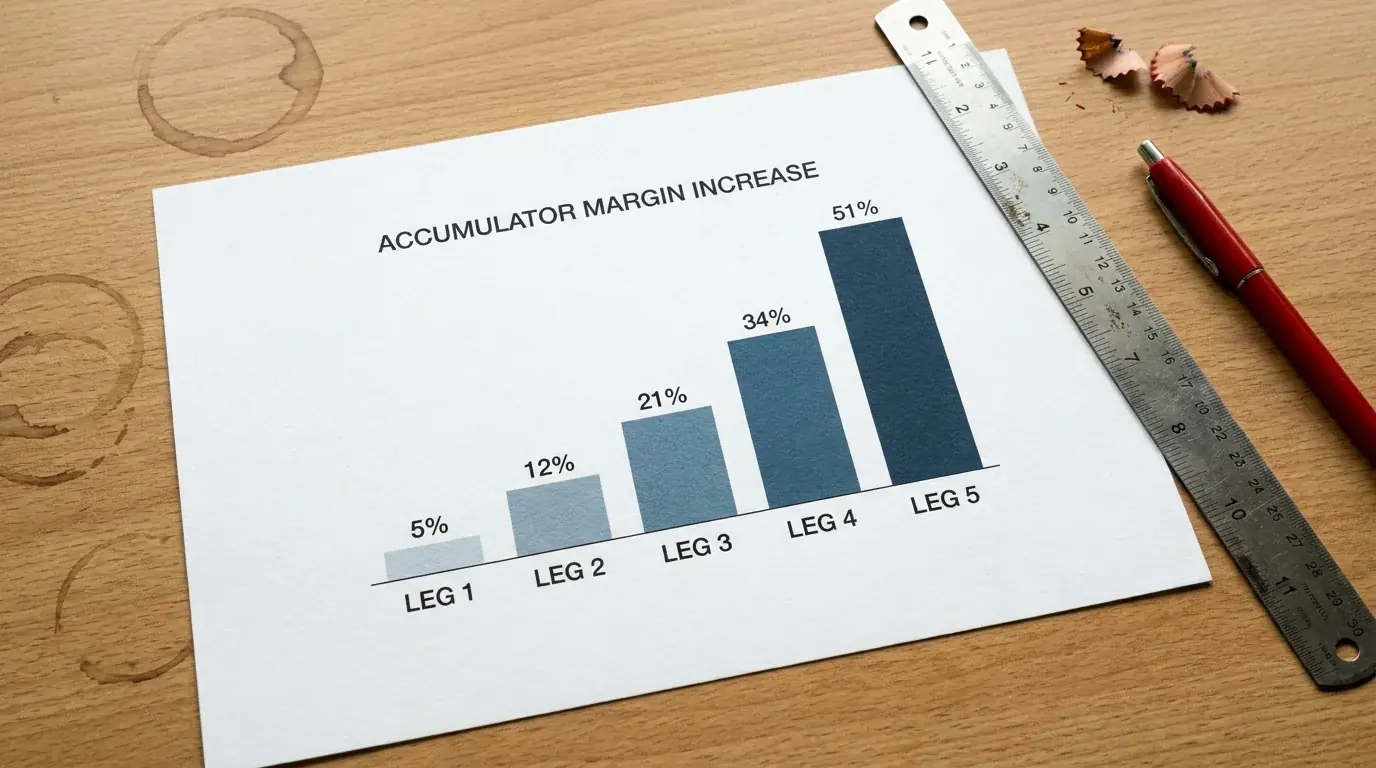
Some punters respond to this by seeking out markets with lower overrounds — the Asian handicap market, for instance, typically runs at 102 to 103 per cent, which compounds far more slowly. A five-fold Asian handicap acca at 102.5 per cent per leg produces an effective margin of about 13.1 per cent — roughly the same as a three-fold on the 1X2 market. The trade-off is that handicap markets are harder to predict and the odds are shorter, so the potential return per leg is lower. There is no free lunch, but there are cheaper restaurants.

Acca Boosts: Marketing or Genuine Value?
Would you rather have a 10 per cent acca boost on a five-fold with a 22 per cent built-in margin, or no boost at all on a five-fold with a 13 per cent margin? I ask this question at every talk I give, and almost everyone picks the boost. They are wrong — the unboosted bet with lower underlying margin gives you better expected value. And this is precisely the illusion the acca boost is designed to create.
Acca boosts typically add between 5 and 50 per cent to the potential return on a qualifying accumulator, with the percentage increasing as more legs are added. A four-fold might get a 10 per cent boost; a seven-fold might get 40 per cent. On the surface, it looks like free money. In practice, the boost rarely compensates for the compounded overround, especially on longer accumulators.
Consider a five-fold with combined decimal odds of 15.00 before the boost. A 20 per cent boost raises the potential return from 15x to 18x your stake. But if the fair odds on that combination — stripped of all margin — were actually 21.00, the boosted price of 18.00 still leaves you paying a 14.3 per cent margin. The boost improved your position relative to the unboosted price, but it did not eliminate the house edge or even bring it close to fair.
The context here matters. Remote Gaming Duty nearly doubled from 21 per cent to 40 per cent in April 2026 — the largest single gambling tax increase in UK history. The government’s impact assessment explicitly anticipated that operators would pass up to 90 per cent of that increase onto consumers through reduced odds and payouts. Acca boosts are one of the levers bookmakers use to manage that pass-through: they can tighten the underlying odds while simultaneously introducing or increasing boost percentages, so punters feel like they are getting a better deal while the effective margin stays the same or even grows. Watch the base price, not the boost.
Where boosts do offer genuine value is on shorter accumulators — two or three legs — where the compounded margin is still moderate and a 10 per cent bump can tip the effective odds past the fair price line. I track these weekly and find value in roughly one in five promoted boost offers on trebles. On five-folds and above, the hit rate drops to near zero.

Acca Insurance: Terms, Limits and When It Pays Off
Acca insurance sounds like a safety net: place a five-fold, and if one leg lets you down, the bookmaker refunds your stake as a free bet. The promotional copy makes it feel like the bookmaker is sharing your risk. In reality, the terms attached to most insurance offers make the expected cost to the bookmaker surprisingly low — and the expected benefit to you much smaller than the headline suggests.
Start with the trigger: most insurance requires a minimum number of legs (typically four or five), minimum odds per leg (usually 1.20 or higher), and a qualifying stake that meets certain conditions. If any of those criteria are not met, the insurance does not activate. Then consider the payout: the refund comes as a free bet, not cash. A free bet is worth substantially less than its face value because the stake is not returned on a winning free bet. A GBP 10 free bet on a 4.00 selection returns GBP 30 (the GBP 40 payout minus the GBP 10 non-returned stake), giving the free bet an effective value of roughly GBP 7.50 on average. So your “full refund” is really a 75 per cent refund in expected terms.
On top of that, the probability of exactly one leg letting you down — the scenario where insurance triggers — is lower than most punters assume. On a five-fold, the most common outcomes are either all five winning (low probability), multiple legs losing (high probability), or all legs losing (moderate probability). The specific case of exactly four winners and one loser sits somewhere in between and depends on the individual leg probabilities, but it is typically not the most likely losing scenario. For most five-folds, the chance of exactly one leg failing is around 20 to 30 per cent — meaning 70 to 80 per cent of the time you lose, the insurance does not help.
Grainne Hurst, CEO of the Betting and Gaming Council, has argued publicly that if the regulated sector becomes harder to use or less competitive, customers will simply go elsewhere rather than stop betting. The insurance offer is one tool bookmakers use to keep the regulated experience feeling competitive — it adds perceived value without costing the operator very much. That does not make it worthless, but it does mean you should treat it as a small bonus rather than a reason to add extra legs to your acca.

Each-Way Accumulators for Football: A Hidden Edge?
Each-way accumulators are the quiet corner of the acca market that hardly anyone talks about, partly because they are harder to understand and partly because very few platforms promote them. The concept borrows from horse racing: instead of your selection needing to win outright, it needs to “place” — finish in one of the qualifying positions. In football terms, a typical each-way acca on a Premier League outright market pays a fraction of the odds (usually 1/4 or 1/5) if your selection finishes in a designated place range, say the top four.
The edge comes from the place terms. Bookmakers set their each-way fractions based on horse racing conventions, and those fractions are not always accurately calibrated for football outrights. In a 20-team league, a “top four” place term covers 20 per cent of the field, but the implied probability of any individual team finishing in the top four is often mispriced relative to the place fraction applied. I have found consistent small edges on each-way accas for mid-table teams — sides priced at 30/1 or longer for the title, where the place odds at 1/4 effectively give you 7.5/1 for a top-four finish, and the true probability of that finish is higher than the implied 11.8 per cent.
The downside is liquidity and availability. Not all platforms offer each-way terms on football outrights, and the ones that do sometimes restrict which markets qualify for acca inclusion. It is a niche strategy for patient punters willing to dig into the numbers, but for those who make the effort, the place market on football outrights remains one of the least efficiently priced areas of the UK market.
Accumulators vs Bet Builders: Picking the Right Tool
I get asked this at least once a week: should I use an accumulator or a bet builder? The answer depends entirely on whether your selections come from the same match or different matches — and on how correlated those selections are.
An accumulator combines selections from different, independent events. Manchester United to win at 2.10, Arsenal to win at 1.65, Liverpool to win at 1.40. These outcomes do not influence each other, so the standard multiplication of odds is mathematically valid. The margin stacks through the overround on each individual leg, but there is no additional correlation penalty.
A bet builder combines selections from the same match, where outcomes are statistically dependent. As I covered in the builder guide, the pricing engine applies a correlation adjustment on top of the overround, which means you pay a second layer of margin. For combinations with high positive correlation, the bet builder is more expensive than an equivalent acca would be if the legs were independent.
The practical rule I follow: if my selections span multiple matches, I use an accumulator. If they centre on one match, I use a bet builder — but I keep the legs to three or four and focus on low-correlation combinations. What I never do is build a bet builder and then fold it into a larger accumulator across matches. Some platforms allow this, and the margin stacking becomes genuinely extreme — you are paying the correlation penalty on the builder legs plus the compounding overround on the acca legs, layered on top of each other. That is where the house edge crosses from manageable to absurd.
Bankroll Management for Accumulator Bettors
Two years ago I reviewed the betting history of a friend who had placed 312 accumulators in a single season. His total stake was just over GBP 3,100 — an average of GBP 10 per acca. His total returns were GBP 1,840. He had lost GBP 1,260 and did not even realise it, because two big winners in November had created the illusion of a profitable year. The losses were spread across hundreds of small, invisible disappointments.
Accumulators produce lumpy, unpredictable returns. You can go weeks without a single winner and then hit a five-fold that recovers everything and more. This pattern makes it extremely difficult to assess your performance in real time and dangerously easy to chase losses during dry spells. The 18-to-24 age group in the UK reports the highest rate of problem gambling — 5.3 per cent scoring 8 or above on the PGSI scale — and accumulators, with their volatile return profile and social media visibility, are a product this demographic gravitates toward.
My staking rules for accumulators are simple. First, I never stake more than 1 per cent of my betting bankroll on any single acca. If my bankroll is GBP 500, a single accumulator gets GBP 5 maximum. Second, I set a weekly acca budget and stop when it is spent, regardless of results. Third, I track every accumulator in a spreadsheet — legs, odds, stake, result, implied margin. The spreadsheet is the only honest record of performance; memory is unreliable and biased toward the winners.
The entertainment value of accumulators is real, and I am not here to argue that everyone should approach them like a hedge fund. But if you want to sustain a betting habit over years rather than months, the bankroll discipline matters more than the selection skill. A brilliant five-fold picker who stakes recklessly will lose more than a mediocre picker with rigid bankroll rules. The maths is unambiguous on this point.

Which UK Bookmakers Offer the Best Acca Deals
Comparing acca features across UK sportsbooks is less about who has the “best” deal and more about which combination of features aligns with your specific acca strategy. The landscape is dominated by a few large operators — Flutter Entertainment, with its $16.38 billion revenue in 2025 and 15.9 million average monthly players, runs multiple UK-facing brands that each handle accumulators slightly differently.
The features that actually move the needle for acca bettors fall into four categories: boost structure, insurance terms, maximum payout limits and cashout availability. Boost structures vary enormously — some platforms offer escalating boosts that increase with each leg added, while others provide a flat percentage regardless of the number of selections. Insurance triggers range from requiring four legs minimum to six, and the refund comes either as a free bet or, more rarely, as cash. Maximum payouts on accumulators can catch you out: some platforms cap winnings at GBP 500,000 or GBP 1 million, which sounds generous until you build a long-odds ten-fold that theoretically returns more than the cap.
bet365 posted GBP 4.036 billion in revenue for financial year 2024/25, with sports betting turnover growing 5 per cent. Their acca products have historically offered competitive base odds with moderate boost percentages, and their cashout function on accumulators is among the fastest to settle in the UK market. Other large operators compete primarily on promotional generosity — bigger boosts, more frequent insurance offers — while running slightly wider overrounds on the underlying legs. The net effect can be a wash: the flashier promotion compensates for the higher margin, landing you in roughly the same place as a platform with tighter base odds and no promotions.
My advice is to ignore the promotional noise and focus on the base overround per leg. Build the same acca on three platforms without applying any boosts, compare the combined odds, then check which platform offers the most valuable boost on top. That two-step process consistently identifies the best effective price, and it takes less than three minutes.

How many legs do I need for an accumulator bet?
A minimum of two selections makes a double, which is the simplest accumulator. Most promotional features like acca boosts and insurance require at least four or five legs to activate. There is no universal maximum, though platforms typically cap the number of selections between 14 and 20 legs. From a value perspective, accumulators beyond five or six legs carry such a high compounded margin that the expected return drops sharply.
Are acca boosts worth it or just a marketing tool?
Acca boosts add genuine value in a narrow set of circumstances — primarily on shorter accumulators of two or three legs where the compounded overround is still moderate and the boost percentage tips the effective odds past the fair price. On five-folds and above, the underlying margin is typically large enough that even a 30 or 40 per cent boost fails to bring the price back to fair value. Always check the base odds before applying the boost.
What happens if one match in my accumulator is postponed?
If a match in your accumulator is postponed and not rescheduled within a set window, that leg is typically voided and the acca recalculates at reduced odds. A five-fold becomes a four-fold, a four-fold becomes a treble, and so on. The exact rules vary by platform — some void the leg immediately, others wait for a rescheduled date. Check the specific terms of your bookmaker, particularly around cup ties and international fixtures where rescheduling is common.
Can I combine accumulator insurance with a cash-out?
In most cases, using the cash-out function on an acca voids the insurance protection. The insurance typically requires the bet to run to full settlement for the refund to activate. If you cash out partway through — even if the remaining legs go on to lose — the insurer considers the bet settled and the free bet refund does not apply. A few platforms have experimented with partial cash-out that preserves insurance eligibility, but this remains rare.
Created by the ”Football Betting Sites” editorial team.