
Football Betting Strategy: Staking Plans, Models and Long-Term Profitability
 Available in US

Strategy is what separates a bettor who’s been doing this for nine years from someone who’s been doing the same year nine times. Football generated £1.3 billion in remote betting GGY across the UK to March 2025 — and the vast majority of that revenue comes from punters who have no systematic approach to staking, selection or record-keeping. A framework doesn’t guarantee profit. But without one, you’re guaranteed to have no idea whether your approach works, and no way to improve it.
Flat Stakes, Kelly Criterion and Proportional Staking
Three years into my betting career, I blew a carefully built bankroll in a single week because I doubled my stakes after a winning run and then chased when the results turned. I hadn’t learned about staking discipline yet. It’s the most expensive lesson I’ve paid for.
Flat staking is the simplest plan: bet the same amount on every selection regardless of confidence or odds. If your bankroll is £500, you might stake £5 per bet — 1% of the total. The advantage is emotional simplicity. You don’t make staking decisions under pressure, and your exposure is constant. The disadvantage: it treats a 55% edge on a 1.50 favourite the same as a 55% edge on a 5.00 outsider, even though the optimal stake for each is very different.
The Kelly Criterion addresses this by scaling your stake to your edge and the odds. The formula: stake = (bp – q) / b, where b is the decimal odds minus 1, p is your estimated probability of winning and q is 1 minus p. If you believe a selection has a 40% chance of winning at decimal odds of 3.00, Kelly suggests staking (2 x 0.40 – 0.60) / 2 = 0.10, or 10% of your bankroll. That’s aggressive — most practitioners use fractional Kelly (quarter or half the full Kelly recommendation) to smooth out variance.
Proportional staking sits between the two. You adjust stake size based on bankroll — if your bankroll grows, stakes grow proportionally; if it shrinks, stakes shrink. This protects against ruin during losing streaks better than flat staking while avoiding the complexity of Kelly. Most bettors I know who’ve been profitable over multiple years use some version of proportional staking with a confidence-based adjustment (staking 1-3% of bankroll depending on how strong the edge appears).

Poisson and Regression Models for Football Predictions
Every month, roughly 290 million online bets are placed on real events across the UK. The majority are based on gut feeling, loyalty or tips from social media. A Poisson model is a way to move past that.
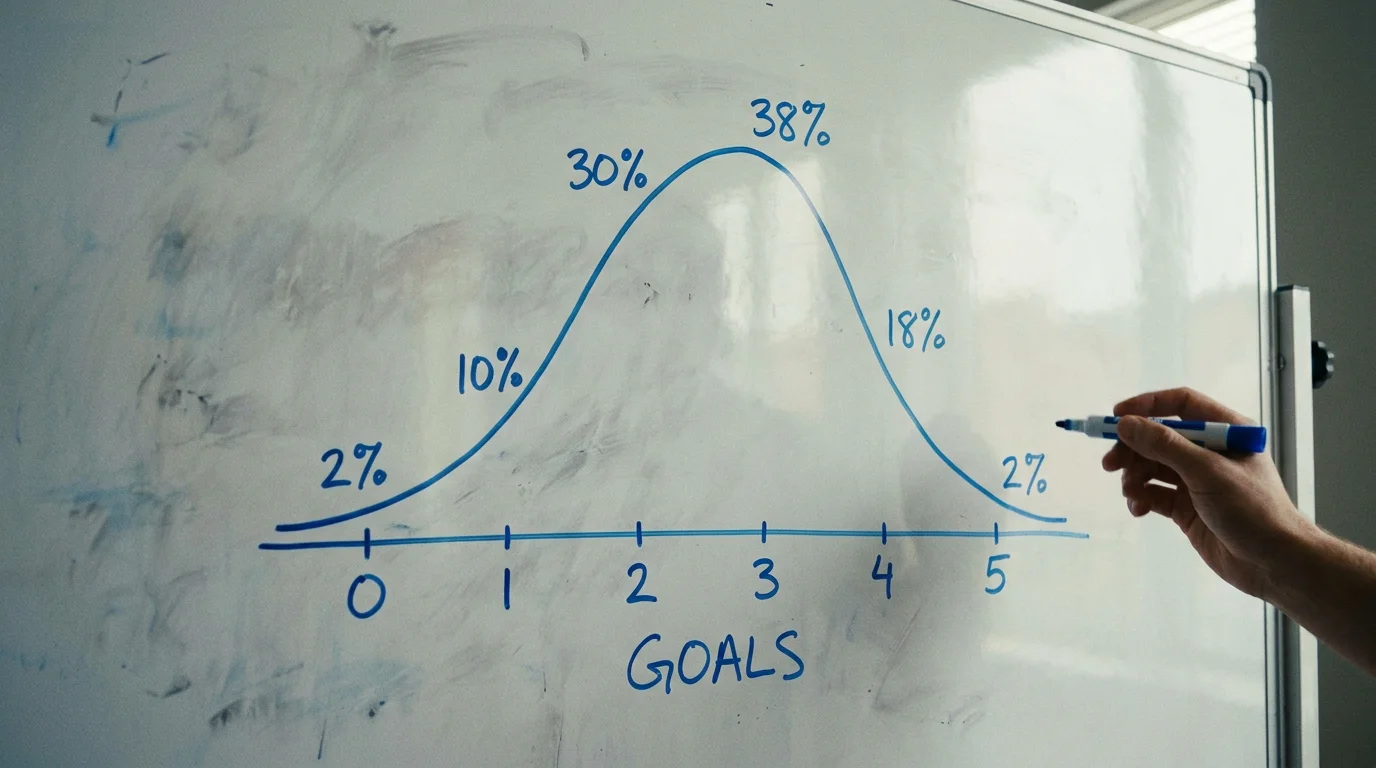
The Poisson distribution models the probability of a given number of events occurring in a fixed interval — perfect for football, where you’re estimating how many goals each team will score. The inputs are simple: the expected goals (xG) for each team based on historical data, adjusted for home/away, opponent strength and recent form. From those two inputs, the model generates probabilities for every possible scoreline (0-0, 1-0, 0-1, 1-1, etc.), which you can sum to get match-result probabilities, over/under lines and BTTS likelihoods.
A basic Poisson model for a match where Team A is expected to score 1.6 goals and Team B 1.1 goals produces a home-win probability of roughly 50%, draw 23% and away win 27%. You convert those to fair odds (2.00, 4.35, 3.70), compare them to the bookmaker’s prices, and any selection where the bookmaker’s price exceeds your fair price is a potential value bet.
Regression models take this further by incorporating additional variables: shots on target, defensive pressure indices, managerial tenure, squad rotation patterns, rest days between fixtures. The complexity scales quickly, but the principle is the same — convert data into probabilities, convert probabilities into fair prices, and compare those prices to the market.
Integrating Strategy With Expected Value Analysis
A model without a staking plan is analysis without action. A staking plan without a model is action without analysis. The integration point is expected value. Your model tells you the EV of each selection. Your staking plan tells you how much to risk based on that EV. Together, they create a complete system.
The UK online sports betting market generated $8,284 million in revenue during 2025, and the operators behind that revenue use precisely this framework in reverse: their pricing models estimate probabilities, their margin model determines how much to shade the odds, and their liability management determines how much to accept on each market. As a bettor, you’re running the same process from the opposite side — and the strategic question is whether your probability estimates are accurate enough to overcome the bookmaker’s margin.

Tracking ROI and Yield: What Counts as Profitable
ROI — return on investment — measures total profit as a percentage of total stakes. If you’ve staked £10,000 over a season and your profit is £300, your ROI is 3%. Yield is the same calculation. A 3% yield across a large sample of bets (500+) is genuine profitability. A 3% yield across 50 bets is statistical noise that tells you very little.
Closing line value (CLV) is the leading indicator. If you’re consistently taking prices above the closing line, your method is generating positive EV even if short-term results are negative. CLV over 500+ bets is a more reliable signal than ROI over the same sample because it’s less affected by variance.
I review my records monthly. The metrics I track: total bets, total stakes, P&L, ROI, average CLV, win rate, average odds taken, and performance broken down by league, market type and staking tier. This granularity reveals where my edge is real and where I’m fooling myself. Some months, the headline ROI looks good but the CLV is negative — meaning I got lucky. Other months, the ROI is negative but the CLV is positive — meaning I was unlucky but the process was sound.

Strategy in football betting isn’t a secret formula. It’s the discipline to build a model, apply a staking plan, record everything, review honestly, and adjust when the data says you’re wrong. None of those steps requires exceptional talent. All of them require consistency — and consistency, over the hundreds of bets needed to separate signal from noise, is the rarest quality in this market.

How many bets do I need to track before judging a strategy?
At minimum 500 bets, ideally 1,000 or more. Football outcomes carry high variance, meaning short-term results are dominated by luck rather than skill. Closing line value is a faster signal than ROI — if your average CLV is positive over 300+ bets, that’s a credible early indicator of a sound method.
Is the Kelly Criterion practical for casual football bettors?
Full Kelly staking is too aggressive for most people — it produces large swings that are psychologically difficult and financially risky if your probability estimates are even slightly off. Fractional Kelly (quarter or half Kelly) is more practical, and many successful bettors default to a simpler proportional staking model with a 1-3% bankroll range.
Prepared by the Football Betting Sites editorial staff.