Asian Handicap Football Betting: How Quarter-Goal and Half-Goal Lines Work
 Available in US
Asian handicaps confused me for the better part of a year. The concept seemed straightforward — give one team a head start or a deficit — but the moment quarter-goal lines appeared, I lost the thread. Once I finally sat down and worked through the mechanics with real match scenarios, I understood why serious football bettors treat Asian handicaps as their primary market. The draw is eliminated (or nearly so), the margins are tighter than 1X2, and the granularity of the lines lets you express a view on the match far more precisely than a three-way result market ever could.
Quarter, Half and Whole Lines: What Each Means
A whole-goal handicap is the simplest version. If you back a team at -1, they need to win by two or more goals for your bet to win. If they win by exactly one goal, the result lands on the handicap line and your stake is refunded — this is a “push.” If they draw or lose, your bet loses.
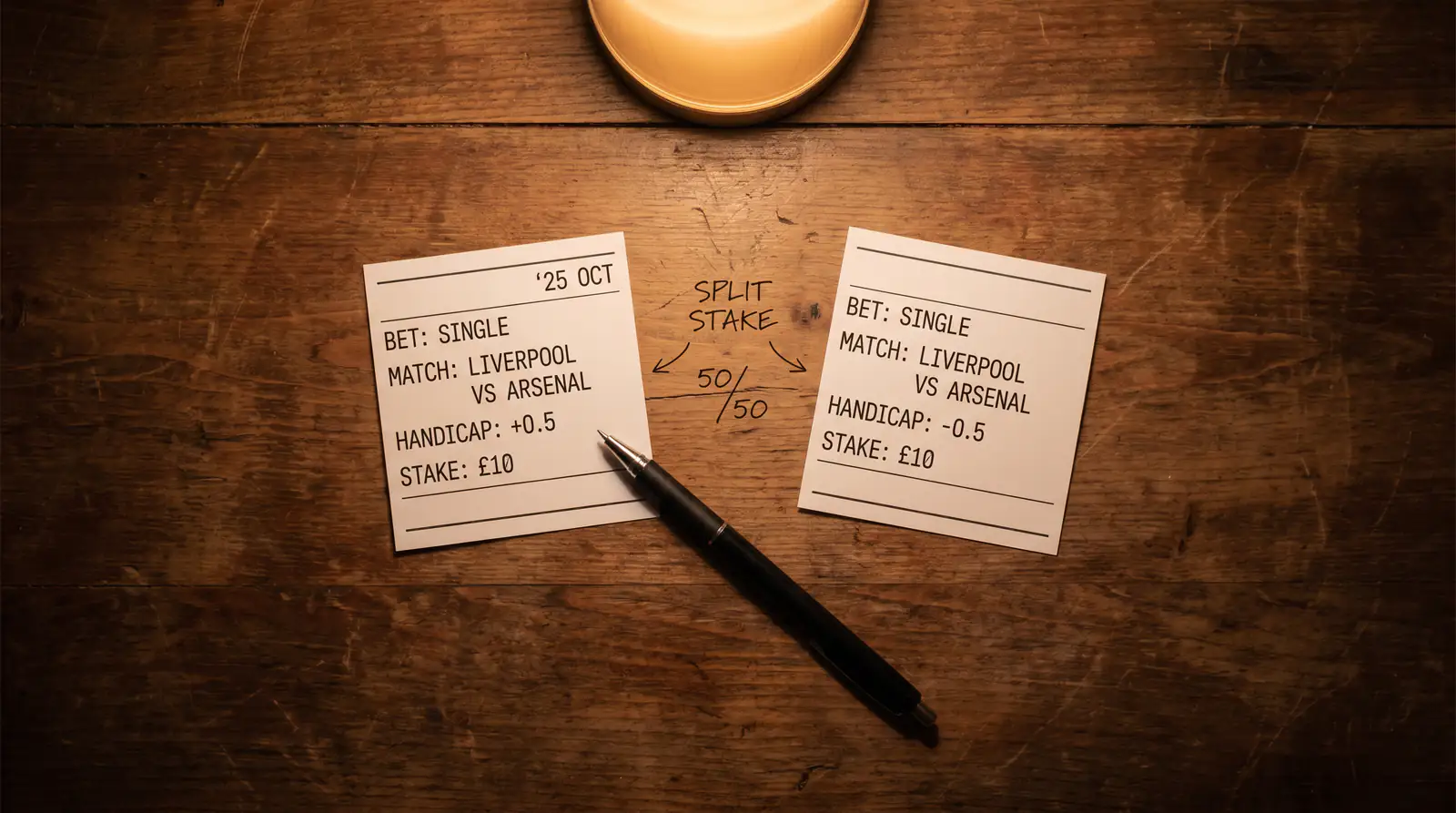
Half-goal handicaps eliminate the push. A team at -0.5 needs to win by any margin. A team at +0.5 needs to avoid defeat — a draw is enough. The half-goal ensures a definitive outcome: your bet either wins or loses, never refunds. These are the most common lines and the ones that most closely resemble a two-way market with no draw option.
Quarter-goal handicaps are where it gets interesting. A line of -0.75 (often written as -0.5, -1.0) splits your stake into two equal halves. One half goes on -0.5, the other on -1.0. If the team wins by exactly one goal, the -0.5 half wins but the -1.0 half pushes. You get a full payout on half your bet and a stake refund on the other half. If the team wins by two or more, both halves win. If the team draws or loses, both halves lose.
The quarter-goal system lets the bookmaker express a price between two round handicap lines. A team too strong for a level handicap but not strong enough for -1 might be priced at -0.75 or -0.25. The split-stake mechanic means your risk and reward sit precisely between the two adjacent lines rather than forcing you into one or the other.
Worked Examples With Real Score Scenarios
Let me run through a concrete match. Suppose you back Team A at -0.75 (Asian Handicap) at odds of 1.95, with a £20 stake. Your stake splits: £10 on -0.5 and £10 on -1.0.
Scenario one: Team A wins 3-1. Both the -0.5 and -1.0 halves win. Your return is £10 x 1.95 = £19.50 from each half, totalling £39.00. Profit: £19.00.
Scenario two: Team A wins 1-0. The -0.5 half wins (Team A won, so -0.5 is covered). The -1.0 half pushes (Team A won by exactly one, matching the line). Your return: £19.50 from the winning half plus £10.00 refund from the push half. Total return: £29.50. Profit: £9.50.

Scenario three: Team A draws 1-1. Both halves lose. The -0.5 side requires a win, and the -1.0 side requires a win by two. A draw fails both. You lose your full £20 stake.
Scenario four: Team A loses 0-2. Both halves lose. Total loss: £20.
The quarter-goal line gives you partial protection on a one-goal win — better than a full loss on -1.0 but less than a full win on -0.5. Think of it as buying insurance on the narrower victory margin.
When Asian Handicap Offers Tighter Margins Than 1X2
This is the practical reason I moved most of my football betting to Asian handicap markets. The margins are consistently tighter. Football generated £1.3 billion in remote betting GGY in the UK to March 2025, and a significant share of the revenue from football betting comes from the 1X2 market’s wider overround. Asian handicaps, by eliminating the draw as a separate outcome and reducing the market to two sides, naturally compress the overround.
On a Premier League match priced with a 1X2 overround of 105%, the equivalent Asian handicap market on the same match might carry an overround of 102-103%. The UK online sports betting market generated $8,284 million in revenue in 2025, with sports betting at 57.1% of the total — and part of the reason that revenue is so large is that most casual bettors stick to 1X2 markets where the margins are widest. Switching to Asian handicaps is one of the simplest ways to reduce the amount you pay in bookmaker margin per bet.

The tighter margins make handicaps especially attractive for accumulator bettors. Since the overround compounds across legs, starting with a 102% base rather than a 105% base on each leg makes an enormous difference across four, five or six selections. A six-fold accumulator built on Asian handicap legs with 102% overround each accumulates roughly 12% effective margin. The same six-fold on 1X2 at 105% each compounds to roughly 34% margin. That gap is why sharp bettors build accumulators on handicap and over/under lines, not match results.

Asian handicap betting requires a slightly different analytical approach than 1X2. Instead of asking “who will win?”, you’re asking “by how much?” or “can this team avoid losing by more than N goals?” That precision pushes you toward thinking about match dynamics — game state, tactical approach, squad depth, fixture context — rather than simply picking winners. It’s harder. It’s also more rewarding, both analytically and financially, because the market pays you for the extra precision through tighter prices and less margin leakage. The learning curve is steeper than 1X2, but the maths is better on the other side.

What happens to my Asian handicap bet if the result lands exactly on the line?
On a whole-goal line (e.g. -1.0), landing exactly on the line results in a push — your stake is refunded in full. On a half-goal line (e.g. -0.5 or +1.5), it is impossible to land on the line because scores are whole numbers. On a quarter-goal line, half your stake may push while the other half wins or loses, depending on the exact score relative to the split lines.
Do all UK bookmakers offer Asian handicap football markets?
All major UK bookmakers offer Asian handicap markets on Premier League, Champions League and other high-profile football fixtures. Coverage thins for lower-league and less popular competitions. Market depth and the range of available handicap lines vary between operators, so checking multiple bookmakers before placing your bet is worthwhile.
Written by the editors at Football Betting Sites.