
Responsible Gambling Tools on UK Betting Sites: Limits, Time-Outs and GamStop
 Available in US

Among 18-24-year-olds in the UK, 5.3% score in the highest problem gambling category on the PGSI scale, and 21.9% show at least some indicators of gambling-related harm. Those numbers aren’t abstract — they represent people whose betting crossed from entertainment into something damaging. Every UKGC-licensed operator is required to offer a set of responsible gambling tools, and most bettors never touch them. I think that’s a mistake, even for people who aren’t at risk. Setting limits is like wearing a seatbelt: you don’t plan on crashing, but the protection costs you nothing and the downside of not having it is severe.
Deposit Limits: How to Set and Adjust Them
Roughly 47% of UK adults participate in some form of gambling within a four-week period. The vast majority do so without harm, but the difference between the majority and the minority often comes down to whether spending boundaries existed before the first bet.
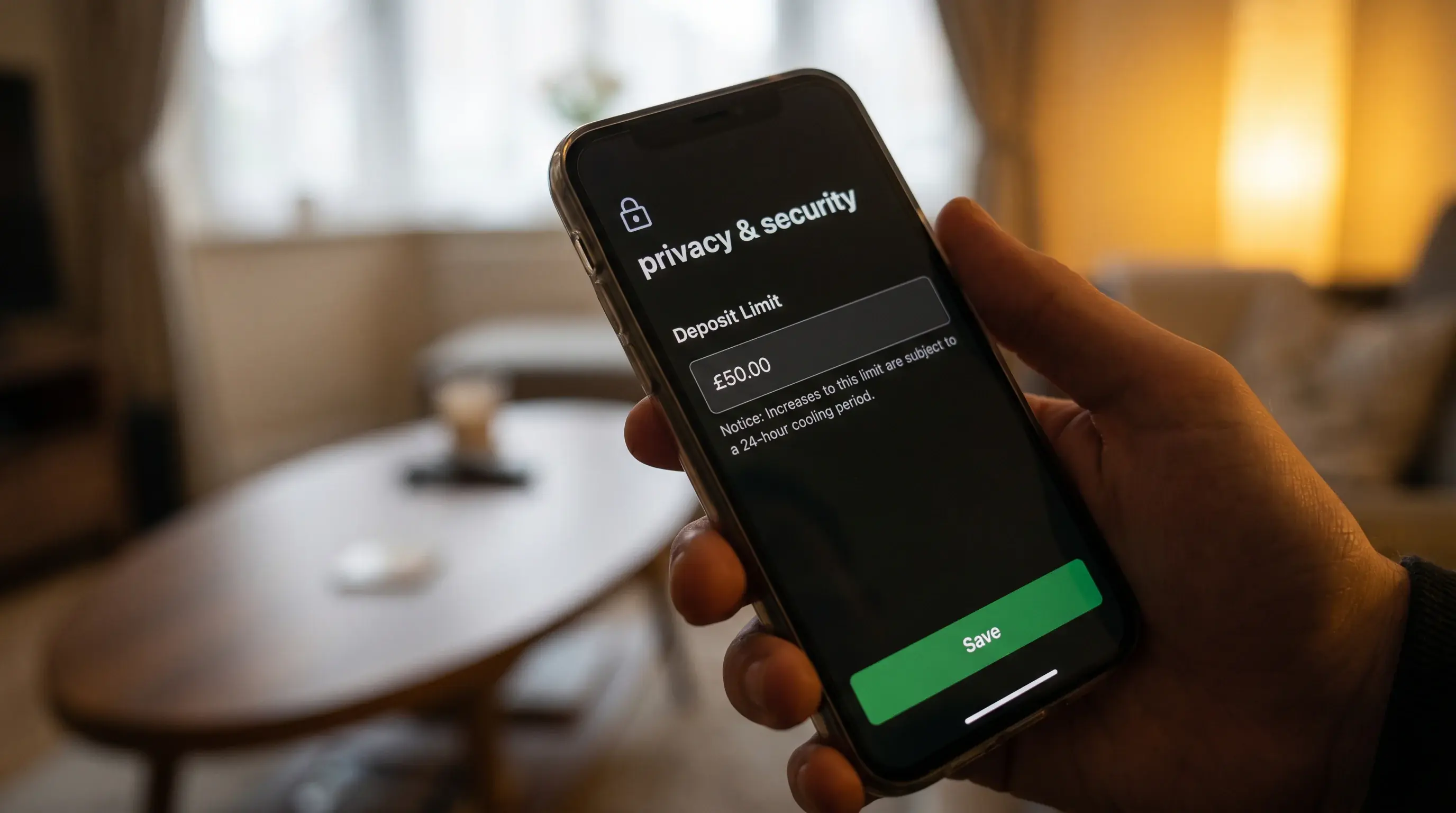
Every UK bookmaker lets you set daily, weekly and monthly deposit limits. The process takes 30 seconds in your account settings. Set a number that you’re comfortable losing entirely — not the amount you hope to spend, but the amount you’d walk away from without financial stress. If your monthly entertainment budget is £100, set your deposit limit at £100. The platform will block any deposit that would push you past the cap.
The asymmetry in limit adjustments is deliberate. You can lower a deposit limit immediately — the change takes effect on your next deposit attempt. But increasing a limit triggers a cooling-off period, typically 24 hours to 7 days depending on the operator. This delay is designed to prevent impulsive limit increases driven by the desire to chase losses. It’s an inconvenience that protects you from your worst decision-making moments, and it works.
Time-Outs and Cool-Off Periods
I took a 72-hour time-out in the middle of last season after a bad run that left me irritated rather than analytical. The break wasn’t because I’d lost control — it was because I could feel my decision-making degrading. I was chasing value that wasn’t there, shortening my analysis and staking above my usual levels. Three days away reset my approach entirely.
Time-outs are temporary account suspensions that you activate yourself. Most UK bookmakers offer periods of 24 hours, 48 hours, 7 days or 30 days. During a time-out, you cannot log in, place bets, deposit or withdraw. The account isn’t closed — it reactivates automatically at the end of the chosen period. No customer service interaction required to resume.

Cool-off periods function similarly but often come with the additional step of removing you from marketing communications during the break. Some operators also pause promotional notifications and email offers for a period after you return, reducing the “welcome back” trigger that can push a returning bettor straight into a deposit.
The distinction between a time-out and self-exclusion matters. A time-out is short, self-initiated and reversible. Self-exclusion is longer, more formal and, in the case of GamStop, covers every UKGC-licensed operator simultaneously.
GamStop Self-Exclusion: What It Covers and How Long It Lasts
GamStop is the UK’s national online self-exclusion scheme. Register with GamStop and you’re blocked from all UKGC-licensed online gambling sites for a minimum period of your choice: 6 months, 1 year or 5 years. Not one site — all of them. The scheme covers every operator that holds a UK gambling licence, which means every legal online bookmaker, casino and bingo site.
Tim Miller of the Gambling Commission has noted that increased gambling participation — from 27% of young people spending their own money on gambling in 2024 to 30% in 2025 — isn’t necessarily driven by children being encouraged to gamble underage, but by increased participation in legal or unregulated forms. GamStop is designed for the regulated space, and it works within that space. What it cannot cover is unlicensed offshore operators, who have no obligation to check the GamStop register.
Registering takes a few minutes online. You provide your name, date of birth, email addresses and any addresses associated with your gambling accounts. GamStop then notifies all participating operators to close or suspend your accounts. The block is robust — attempts to open new accounts at UKGC-licensed sites will be flagged and prevented.

Removing yourself from GamStop before the exclusion period expires is not possible. Once the minimum period ends, you can request removal, but this is a deliberate process — not an automatic reactivation. GamStop contacts you to confirm your decision and offers information about support services before lifting the exclusion. This friction is intentional and, based on conversations I’ve had with people who’ve used the scheme, genuinely valued in retrospect.
How Financial Risk Assessments Add Another Layer
Since February 2025, financial risk assessments add a regulatory backstop to the self-directed tools described above. When your net losses exceed £150 in a rolling 30-day period, the operator runs a background check against credit reference agency data. The pilot found 97% of these checks completed frictionlessly, with no customer interaction required.

The FRA system acts as a safety net for bettors who haven’t set their own limits. If someone is losing money they can’t afford and hasn’t activated deposit limits or time-outs, the FRA is designed to catch the pattern before it escalates. It’s not a replacement for self-directed tools — it’s a complement. The most protected bettor is one who sets their own deposit limits, takes time-outs when decision-making feels impaired and knows that the FRA system provides a background layer of monitoring that catches what self-regulation might miss.
None of these tools eliminates risk. Gambling involves losing money, and no limit or exclusion scheme changes that fundamental fact. What these tools do is create friction between impulse and action — giving you time to think, space to step back, and a hard stop when the boundary you set is reached. Using them isn’t a sign of weakness. It’s the same rational risk management that applies to every other area of life where the potential for harm exists alongside the potential for enjoyment.

Can I reverse a GamStop self-exclusion early?
No. GamStop exclusions cannot be lifted before the chosen minimum period (6 months, 1 year or 5 years) has elapsed. Once the period ends, you can request removal through a deliberate process that includes contact from GamStop and information about support services. The irreversibility during the exclusion period is a core design feature.
Do deposit limits apply across all UK betting sites or just one?
Deposit limits are set per operator — a £100 weekly limit at one bookmaker does not affect your limit at another. If you hold accounts at multiple sites, you need to set limits on each one individually. GamStop is the only tool that applies a single exclusion across all UKGC-licensed operators simultaneously.
Written by the editors at Football Betting Sites.